
Gee's Bend Quilts and the Price of Being Discovered
November 23, 2026 · By Wesley Hall
The Quick Stitch
Gee's Bend quilts are made by the Black women of Gee's Bend, a small community in a bend of the Alabama River also known as Boykin. For generations they pieced bold, improvised quilts from work clothes and whatever fabric they had. The art world took notice after a 2002 exhibition that opened in Houston and traveled to the Whitney Museum in New York, and that attention brought fame along with hard questions about who profits from the work.
I first heard the words Gee's Bend more than ten years ago, at a quilt show, from a quilter I had just met. We were standing in front of somebody else's quilt, talking the way quilters talk at shows, which is mostly about other people's quilts. She mentioned Gee's Bend the way you mention a place everybody already knows.
I did not know it. I nodded anyway. I went home and looked it up, and I have been looking it up ever since.
Years later I saw my first Gee's Bend quilt in person, at the National Museum of African American History and Culture in Washington, DC. Photos had not prepared me for it. In a book, the quilts look like graphic design. Up close, they look like somebody's work week. You can see where the fabric came from. You can see that it was worn first and quilted second.
A Town Inside a River
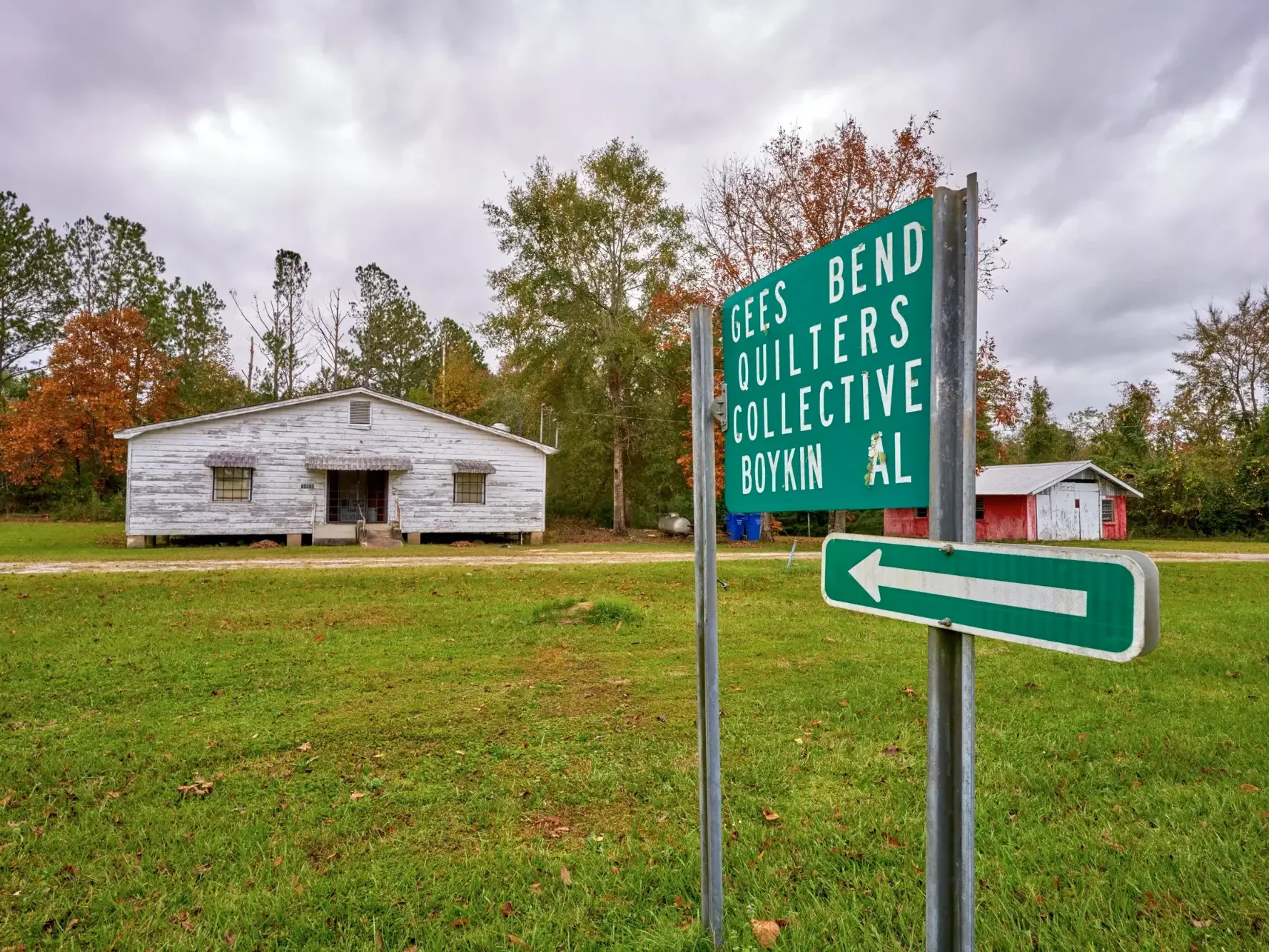
Gee's Bend sits in Wilcox County, Alabama, inside a deep loop of the Alabama River that wraps it on three sides. The people who live there are largely descendants of the enslaved people who worked the cotton plantation on that land, and many of them carry the plantation owner's name, Pettway. In 1949 the community was officially renamed Boykin, after an Alabama congressman named Frank Boykin. Nobody I have ever heard talk about the quilts calls it Boykin. The green sign by the quilters' building splits the difference and uses both names.
The river matters to this story. For years the fastest way to the county seat in Camden was a ferry. In 1962, after residents started riding it across to register to vote, the ferry stopped running. Accounts differ on the official reason. The timing speaks for itself. Martin Luther King Jr. came to Gee's Bend in February 1965 to urge people to register anyway, and the ferry did not come back until 2006. Forty-four years is a long time to wait for a boat.
Quilts Made From What Was There
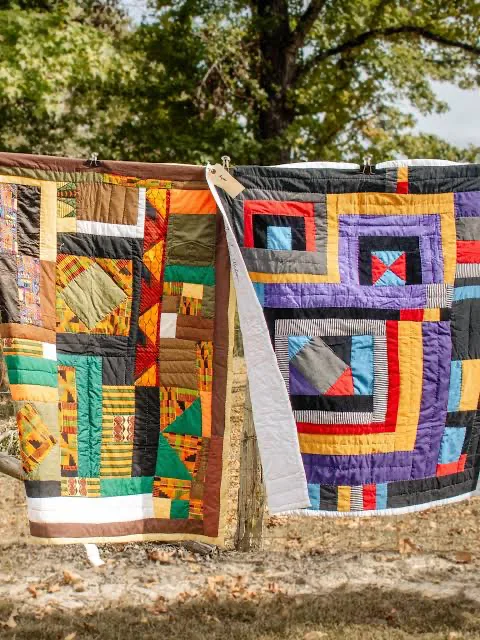
The women of Gee's Bend quilted because people needed to stay warm in houses that did not keep the cold out. They used what they had: worn denim, corduroy, cotton shirts, feed sacks, and the parts of work clothes that still had some life left in them. A faded pair of overalls just meant a softer shade of blue.
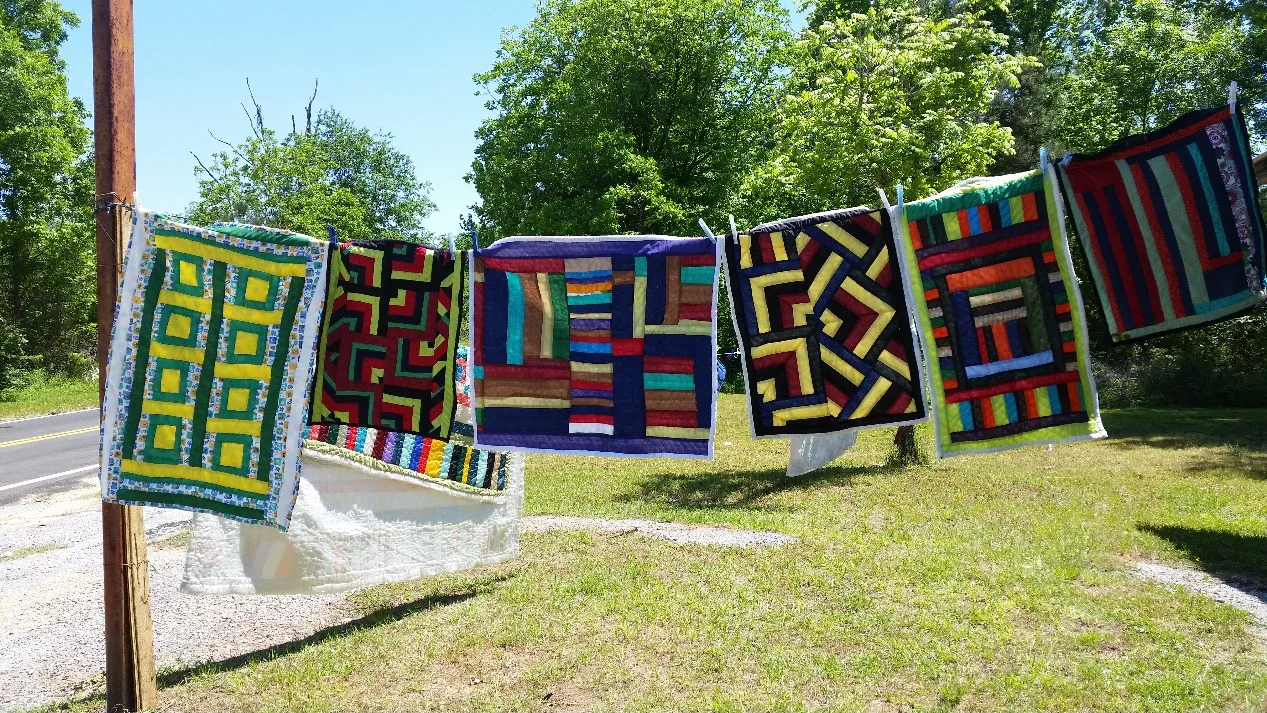
What came out of that looks nothing like the tidy, matched quilts in most pattern books. The blocks have names quilters everywhere would recognize, Housetop and Bricklayer and Log Cabin, but the Gee's Bend versions stretch, tilt, and improvise. Strips change width halfway across. A border stops when the fabric runs out. Art critics later compared the quilts to abstract painting, which tells you more about the critics' reference points than about the quilters, who had never been asked about theirs.
In 1966, in the middle of the civil rights movement, quilters from Gee's Bend and nearby communities organized the Freedom Quilting Bee, a cooperative that sold their quilts to buyers outside the county. It was a way to earn cash in a place where sharecropping had left very little of it. By 1972 the Bee had a contract with Sears to sew pillow covers. That is the part of the story nobody puts on a museum wall: the quilts paid bills long before they were art.
The Discovery
In 1998 an Atlanta collector named William Arnett came across a photograph of a quilt by Annie Mae Young, a work-clothes quilt draped over a woodpile. He went to Gee's Bend and started buying quilts, a lot of them. In 2002, an exhibition called The Quilts of Gee's Bend opened at the Museum of Fine Arts, Houston, then moved to the Whitney Museum of American Art in New York. The New York Times called the quilts "some of the most miraculous works of modern art America has produced."
The quilters of Gee's Bend had been making these quilts for generations. They were discovered in roughly the same sense that Columbus discovered the Bahamas. The people already living there were aware of the place.
Still, the attention was real and some of it was good. A quilters' collective formed in 2003 to sell new work. The women traveled to openings. Museum curators who had never thought of a quilt as anything other than a bedspread started rethinking that.
Who Gets Paid
Then came the lawsuits. In 2007, Annie Mae Young, whose quilt in that photograph started all of this, sued Arnett, his sons, and their company, Tinwood, saying she had been cheated out of money her work earned. Loretta Pettway filed a similar suit and said she had signed copyright paperwork she could not read. Lucinda Pettway Franklin joined later. The Arnetts called the suits frivolous and denied doing anything wrong. In 2008 the suits were dropped. No court ever ruled on whether the quilters were treated fairly.
I am not going to pretend I know what a fair price is for a quilt that ends up in the Whitney. I don't. What I keep coming back to is the shape of the arrangement. A woman makes something with her hands from her family's worn-out clothes. Someone with money and connections buys it for what it is worth in Gee's Bend. Then it travels to New York and becomes worth what it is worth in New York. The gap between those two numbers is where the argument lives.
This is not unique to Gee's Bend. It is the story of blues recordings, of folk art from Appalachia to Haiti, and of nearly every craft made by people without a lawyer. Gee's Bend is just the version where the quilters said so, out loud, in court.
Arnett died in 2020. The foundation he started, Souls Grown Deep, has since placed works from its collection in museums around the country, and Gee's Bend quilts now hang in dozens of them. Some of the women who made them did not live to see it. Their granddaughters are still quilting.
What I Look For Now
When I talk about Gee's Bend with a guild, I don't start with the Whitney. I start with the clothes. Somebody wore that denim to a field. Somebody wore that shirt to church. The quilt is the last job those clothes ever did.
And when I look at one now, I look at the edges where a strip runs out and the maker had to decide what came next, with no pattern telling her what to do.
Out on the road in Boykin there is a green sign with an arrow on it. It has been pointing the same way the whole time.
Bring Gee's Bend to your guild
I talk about the quilters of Gee's Bend, the clothes in their quilts, and the hard questions that came with fame.
More from the Blog
OV Brantley, the Quilter Who Would Not Cut the Rosettes
OV Brantley founded the Atlanta Quilt Festival, built the Good Trouble exhibit, and made A Star Among Stars by refusing the instruction to trim it square.

Harriet Powers and the Quilts That Carried History
Born enslaved in Georgia in 1837, Harriet Powers stitched scripture and local history into narrative quilts. What the record actually says about her work.
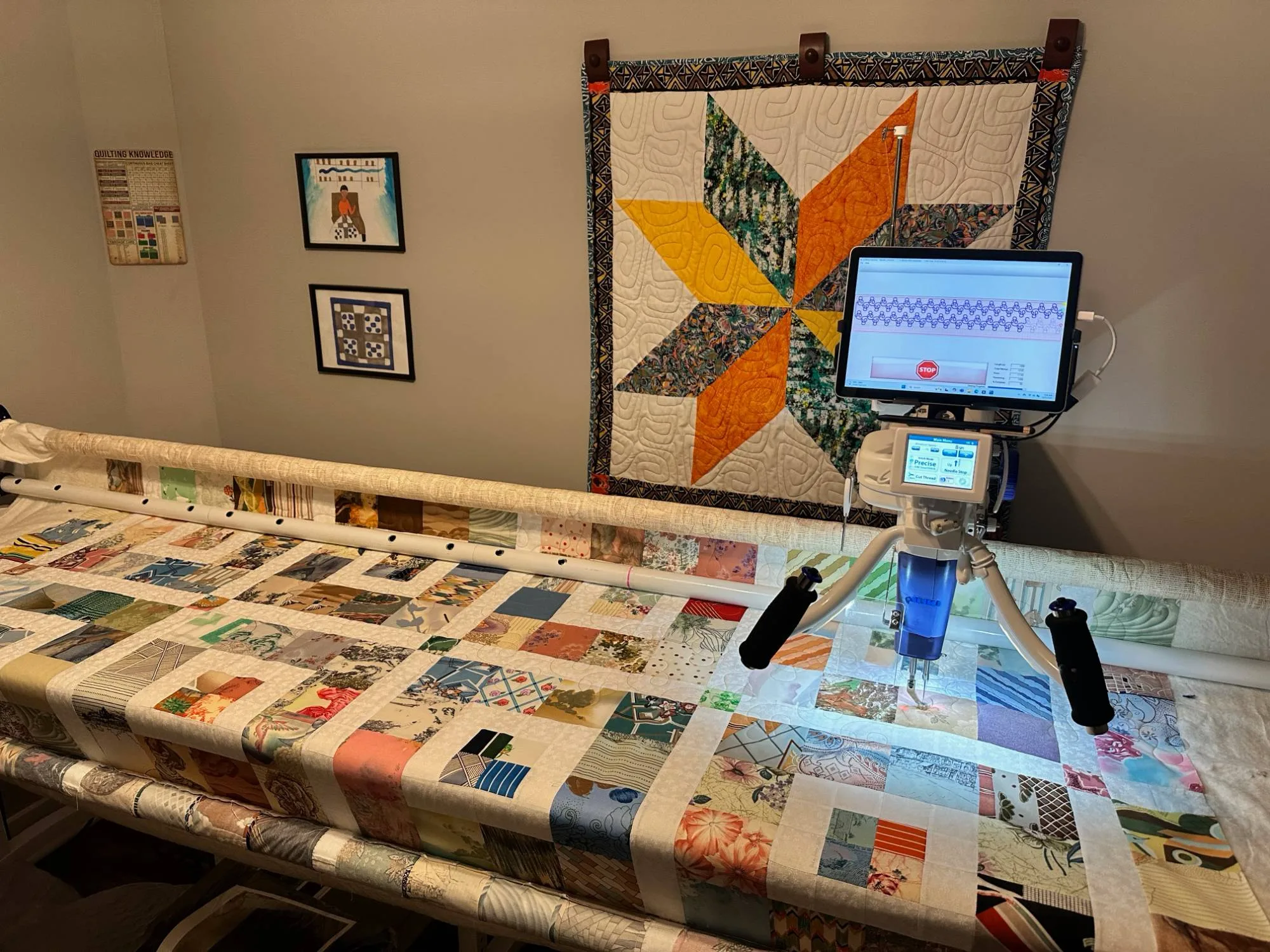
Twenty Years of Lingerie Store Scraps in One Quilt
How I turned twenty years of saved lingerie store scraps into a quilt, and what it took to stabilize and quilt all that thin, slippery silk.
Want to talk about Gee's Bend with your group?
Gee's Bend is one of my favorite subjects to bring to a guild, because everybody has an opinion about who got paid. I give talks on Gee's Bend, Harriet Powers, and the wider history of African American quilting, and I would be glad to hear about your group.