
Harriet Powers and the Quilts That Carried History
September 11, 2026 · By Wesley Hall

I was building a talk on narrative quilts, three weeks out, and I had the usual problem: plenty of pretty pictures and not much to say about them. So I was reading panel descriptions at some indefensible hour of the night, and I hit one that stopped me cold. A description of a quilt block, written down word for word from the woman who made it, about the night the stars fell.
That was Harriet Powers. I rebuilt the whole talk around her in about a week, and I have opened with her at nearly every talk since.
She is often introduced as a folk artist, which is true and also somehow makes her smaller. What she actually was is a historian, working in the only medium available to her.
Born in Georgia in 1837
Harriet Powers was born into slavery in Georgia in October 1837, in the area around Athens. Almost everything about her first three decades comes to us secondhand or not at all, which is the standard condition of the record for enslaved people and something worth sitting with for a second rather than rushing past. She married Armstead Powers. They had children. After emancipation the family farmed in Clarke County, and at one point they held a small piece of land of their own, which they later lost. She died in 1910.
That is a thin biography for a woman whose work hangs in two of the most significant museum collections in the country. It is thin because nobody thought to write it down while she was alive, and because the people who did write things down had other priorities.
Here is the piece of context that matters most to me. Georgia law made it a crime to teach an enslaved person to read and write. That was not a custom or a regional attitude, it was a statute with penalties attached. So an entire population was legally barred from the two technologies that a culture normally uses to keep its own record. And then, a century later, we turn around and note that there is very little written testimony from these communities, as if that were an accident.
The Athens Cotton Fair, and a Five Dollar Sale
In 1886, Powers displayed a quilt at a cotton fair in Athens. A local artist and art teacher named Jennie Smith saw it there. Smith had real training, she had studied art and she knew what she was looking at, and by her own account she was astonished. She offered to buy the quilt. Powers said no.
Five years later, in 1891, Powers came back to her. The family was in financial trouble. In Smith's account, Powers asked ten dollars for the quilt, Smith said she could not pay that much, and the quilt changed hands for five.
Smith also wrote that Powers came to visit the quilt afterward, more than once, the way you would visit a relative who had moved to another town.
I have told that detail from a stage maybe forty times and it never lands softly. A woman parts with the most extraordinary object she will ever make, for five dollars, because five dollars was what her family needed that month, and then keeps coming back to sit with it. That is not a charming anecdote. That is an economic transaction between two people with wildly unequal footing, and it is the reason the quilt survived at all, which is the part that makes it genuinely difficult.
Where the Sources Actually Come From
This is the part I want people to understand before they repeat anything about Harriet Powers, including anything I say.
Nearly everything we know about the meaning of her first quilt comes through Jennie Smith. Smith wrote a notebook account that includes descriptions of the panels as Powers explained them, panel by panel. That manuscript is the primary document. It is the reason we can say with confidence what any given square depicts, from Adam and Eve to Jacob's ladder to Judas and the thirty pieces of silver.
So we have Powers' interpretation, recorded by someone else, filtered through that person's ear, spelling, and assumptions about how a Black woman in 1891 Georgia talked. That is a real and valuable source. It is also not the same thing as Powers writing in her own hand, and scholars have gone back and forth on the question of her literacy, with the evidence pointing different directions depending on which document you hold up. I do not think anyone has settled it. I say so when I speak, because the honest version of the story is more interesting than the tidy one.
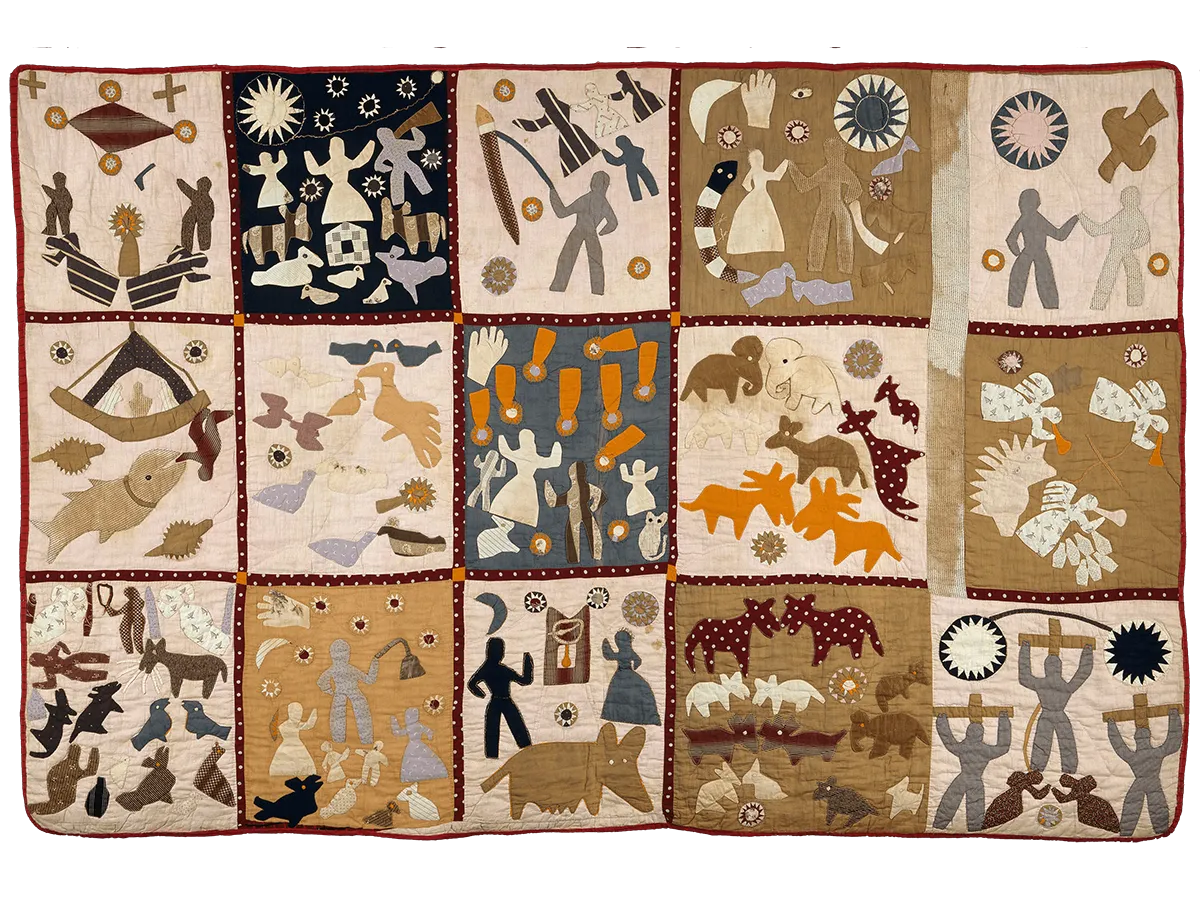
The quilt Smith bought, usually called the Bible Quilt, is now in the Smithsonian's National Museum of American History. It has eleven appliquéd panels. Smith lent it to the Cotton States and International Exposition in Atlanta in 1895, where it was shown in the building dedicated to work by Black Americans.
The Second Quilt
A second Powers quilt survives. It has fifteen panels and it now lives at the Museum of Fine Arts, Boston. The accepted account is that it was commissioned by a group of faculty women connected to Atlanta University, as a gift for a trustee of the school, after her work drew attention at the Atlanta exposition.
What makes this one remarkable is that it is not only scripture. Powers put astronomical and meteorological events into it alongside the biblical scenes, and she dated them. The Leonid meteor storm of November 1833, the night the stars fell, the one I read about at two in the morning. A dark day. A bitterly cold Thursday in February 1895, close enough to the making of the quilt that it would have been fresh news.
Think about what that is. She is placing local memory and catastrophe on the same surface as Genesis, in the same visual grammar, with the same authority. It is not decoration with a story attached. It is a chronicle, and the events she chose to preserve are the ones her community would have counted time by.
The Ingenuity Part
I talk about fabric reuse in almost every presentation I give, usually in the context of somebody's father's shirts, and Powers is where I anchor it.
She was working with what a farming family in postwar Georgia had on hand. Cotton, some of it printed, some of it plain, some of it clearly repurposed. She appliquéd her figures onto pieced grounds, and she used a sewing machine for some of the construction, which surprises people who expect a rural Black woman in the 1880s to be a hand-stitching-only proposition. She used the tools she had, including the modern ones.
Her figures are cut with a confidence that I find almost intimidating. There is no fussing. A hand goes up, a beast has the right number of horns, a sun has rays because a sun has rays. She is not trying to render the world, she is trying to tell you something, and everything that does not serve the telling gets cut away.
Her appliqué is often compared to Fon appliqué traditions from Dahomey, in what is now Benin, and the visual affinity is genuinely striking. I want to be careful there. The comparison is an argument scholars have made, not a documented line of transmission from a specific family to a specific workshop. I raise it in talks as a question worth holding rather than a fact to file away.
What She Is Not
Somebody asks me after nearly every talk whether her quilts are coded, whether the panels are secret instructions, whether there is a map in there.
No. And the interesting thing is that the coded quilt story, which the antebellum documentary record does not support and which historians have pushed back on hard, is a much weaker story than the real one. Harriet Powers did not hide her meaning. She stitched a burning sun and a falling star and a man betrayed for silver, right out in the open, and then she told a visitor exactly what each one meant, and that visitor wrote it down, and we still have it.
She was not smuggling messages. She was publishing.
Why I Open With Her
Because she took the material that was within reach, scraps and sacking and whatever the household could spare, and made a record that outlasted the men who owned her, the fair she showed it at, and the museum labels that first called her work naive.
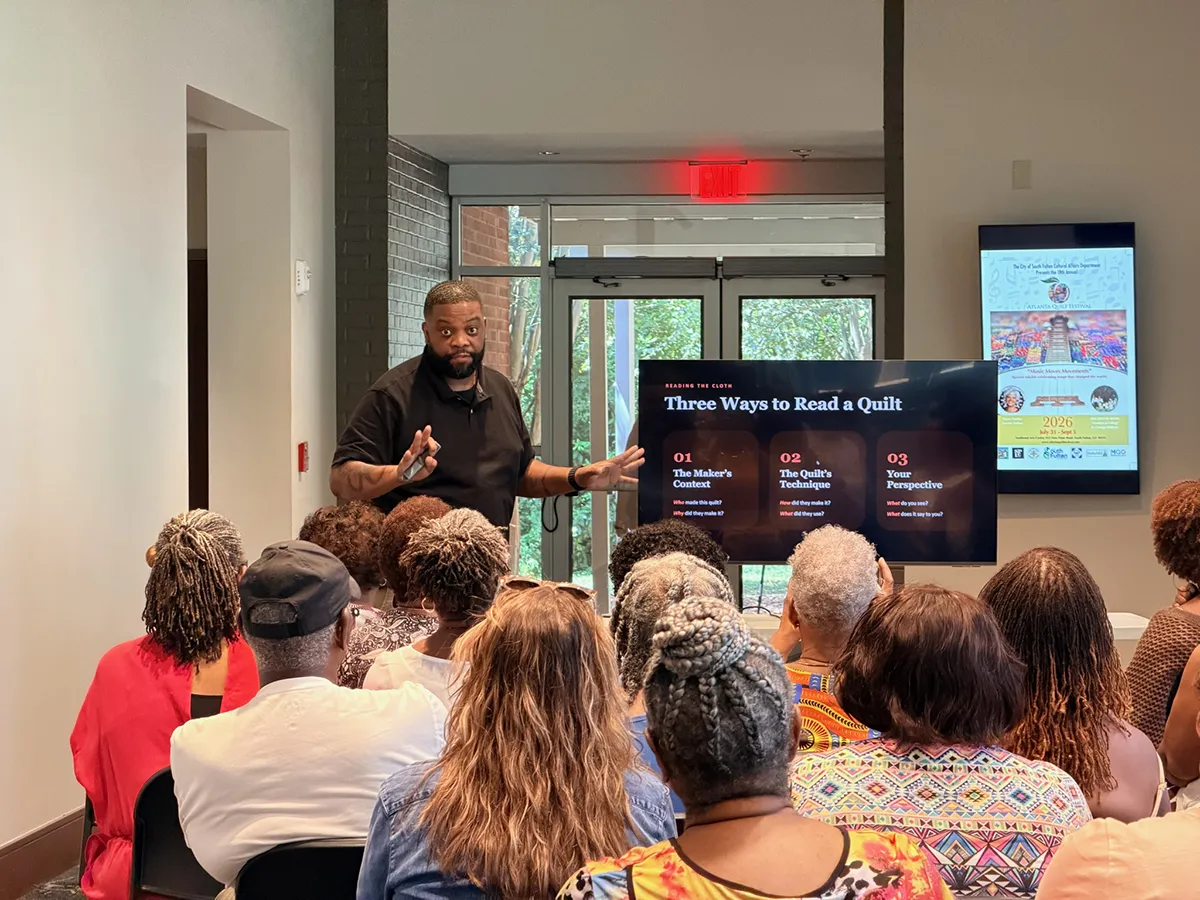
When I stood up at the Atlanta Quilt Festival, an hour or so down the road from where she farmed, I put her first slide up before I said a word about myself. The room got quiet in a particular way. Not a reverent quiet, a recognizing quiet. Everybody in there had made something out of what was left over.
She just did it while the law said she could not write it down.
Bring Harriet Powers to Your Guild
My narrative quilt talk starts with her story, the documents behind it, and what her appliqué still teaches us about working with scraps.
More from the Blog
OV Brantley, the Quilter Who Would Not Cut the Rosettes
OV Brantley founded the Atlanta Quilt Festival, built the Good Trouble exhibit, and made A Star Among Stars by refusing the instruction to trim it square.
The Log Cabin Quilt Block: History, Meaning, and Geometry
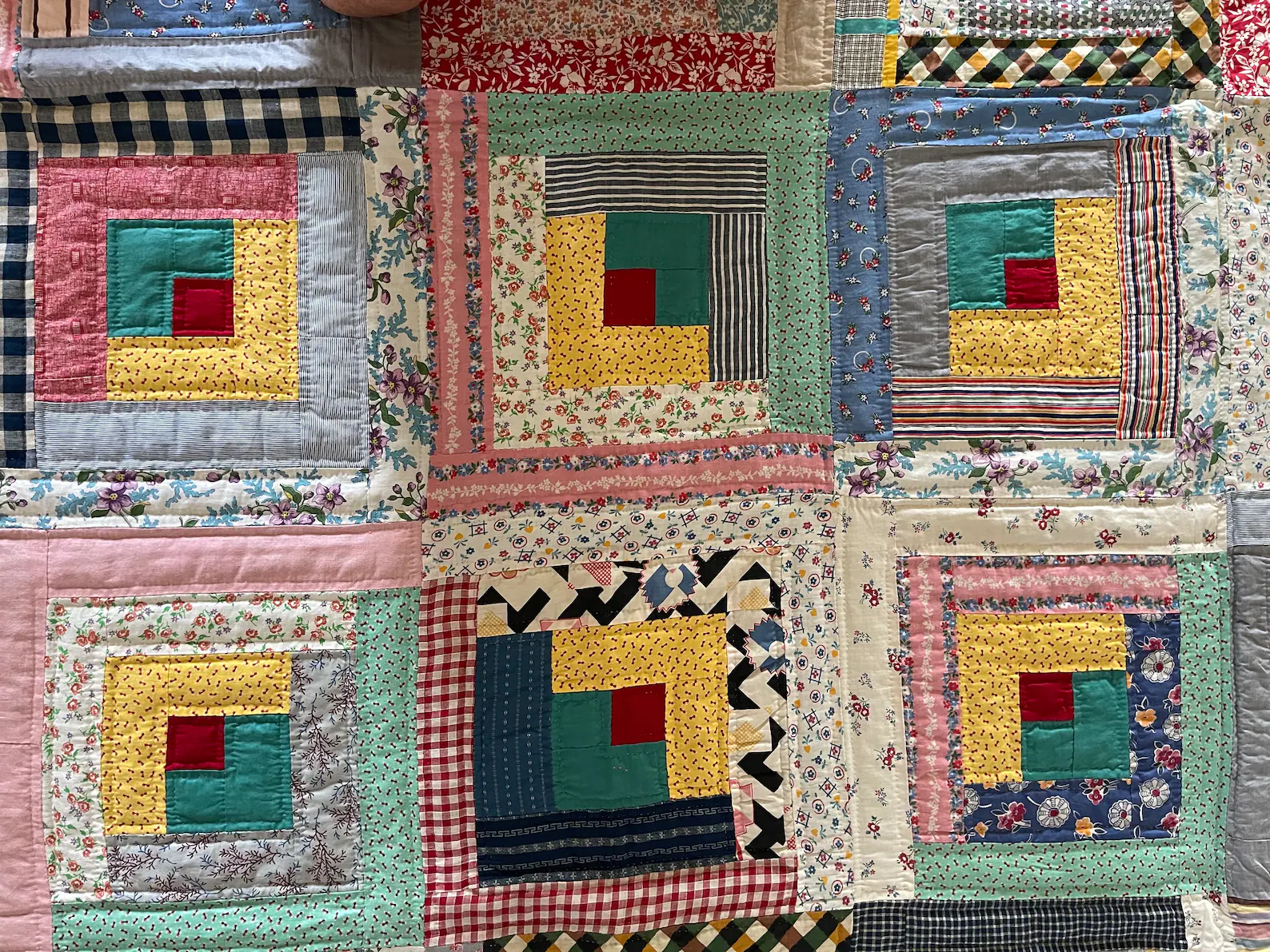
The documented history of the Log Cabin block, what the Underground Railroad claim really rests on, and the geometry behind every classic setting.
The Meaning Behind Popular Quilt Blocks
From the Flying Geese to the Log Cabin, every quilt block has a history. These patterns carry stories passed down through generations of American quilters.
Let Me Tell Your Guild About Harriet Powers
Her two surviving quilts carry scripture, a meteor storm, and a bitterly cold Thursday in 1895, all stitched by a woman the law had barred from writing. I talk about her work, the documents behind it, and what narrative quilting asks of us now.