
The Log Cabin Quilt Block: History, Meaning, and Geometry
September 12, 2026 · By Wesley Hall
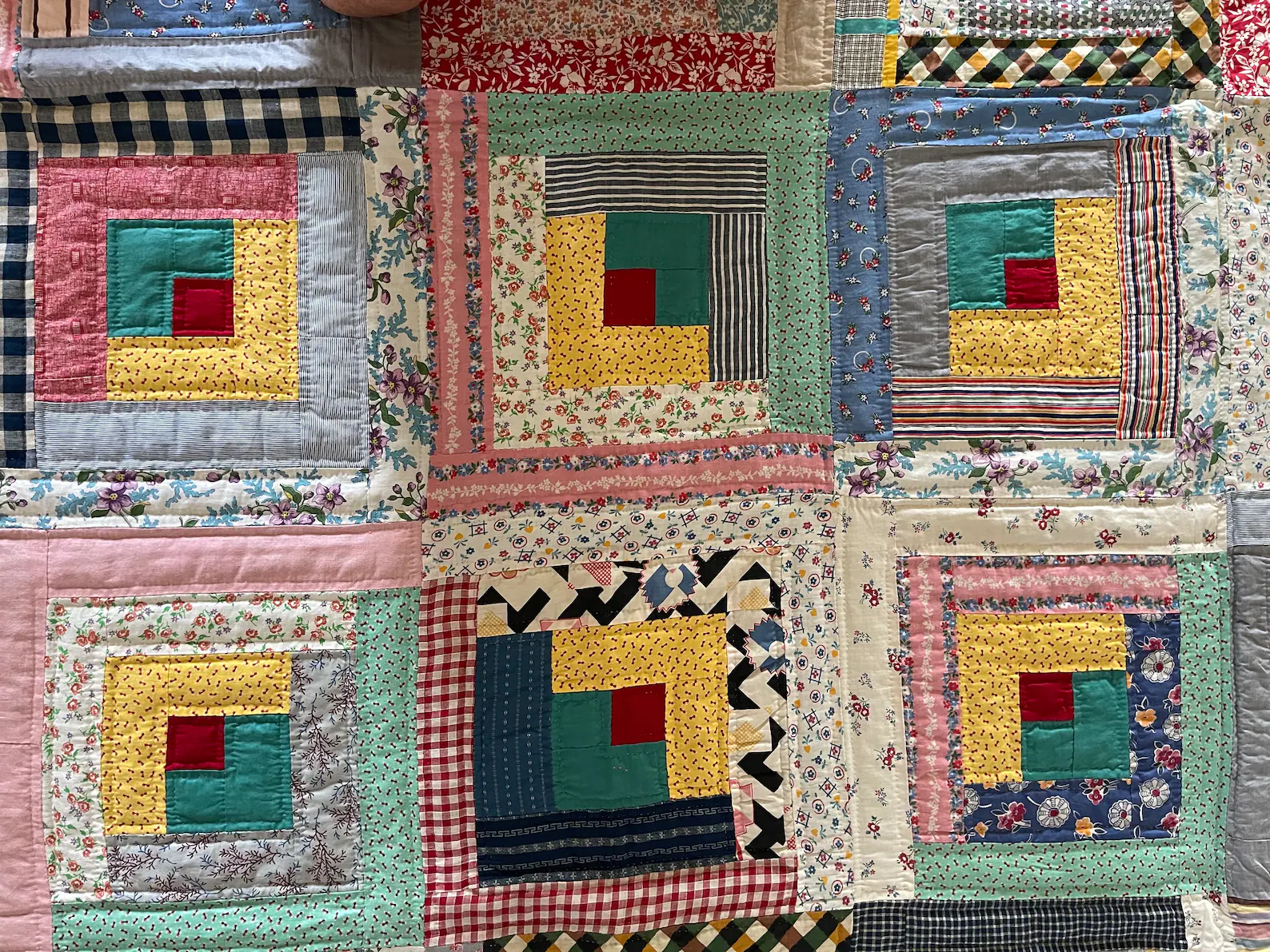
I read Hidden in Plain View before I had pieced anything worth keeping. I finished it on a Sunday, and by the following weekend I was at a machine cutting strips, and the first block I made that I would call a real block, not a practice square, not a thing I threw away, was a Log Cabin. A red center, lights on one side, darks on the other. It was crooked in a way I did not have the vocabulary to describe yet. I still have it.
What I did not understand at the time was that I had picked up the single most contested block in American quilt history and the single most mathematically elegant one, and that those two facts have almost nothing to do with each other.
What the Record Actually Shows
The Log Cabin appears in the American quilt record in the middle of the nineteenth century, and it appears suddenly. That is the part that surprises people. Blocks usually creep in. This one shows up in quantity around the 1860s and then becomes, within a couple of decades, one of the most widely made patterns in the country. Barbara Brackman's block indexing work and the state documentation projects that swept through American attics in the 1980s and 1990s tell a consistent story here: very little before mid century, an enormous amount after.
The name is doing obvious political work. Log cabins meant something specific in nineteenth century American campaign language, and by the Civil War era the cabin had been thoroughly absorbed into the iconography around Lincoln. Quilts made for Sanitary Commission fundraising fairs, the enormous wartime relief efforts that turned needlework into money for soldiers, sit in that same cultural moment. Whether individual makers were thinking about politics when they cut their strips is not something the fabric can tell us. But the name arrived attached to a set of ideas, and it stuck.
There is a persistent story that the form descends from ancient Egyptian textiles or from British folk traditions, and you will see it repeated confidently. The honest position is that visually similar concentric constructions turn up in a lot of places, because wrapping strips around a center is not a difficult idea to arrive at independently. A resemblance is not a lineage. What we can document is that the American Log Cabin became a mass phenomenon in the second half of the nineteenth century and stayed one.
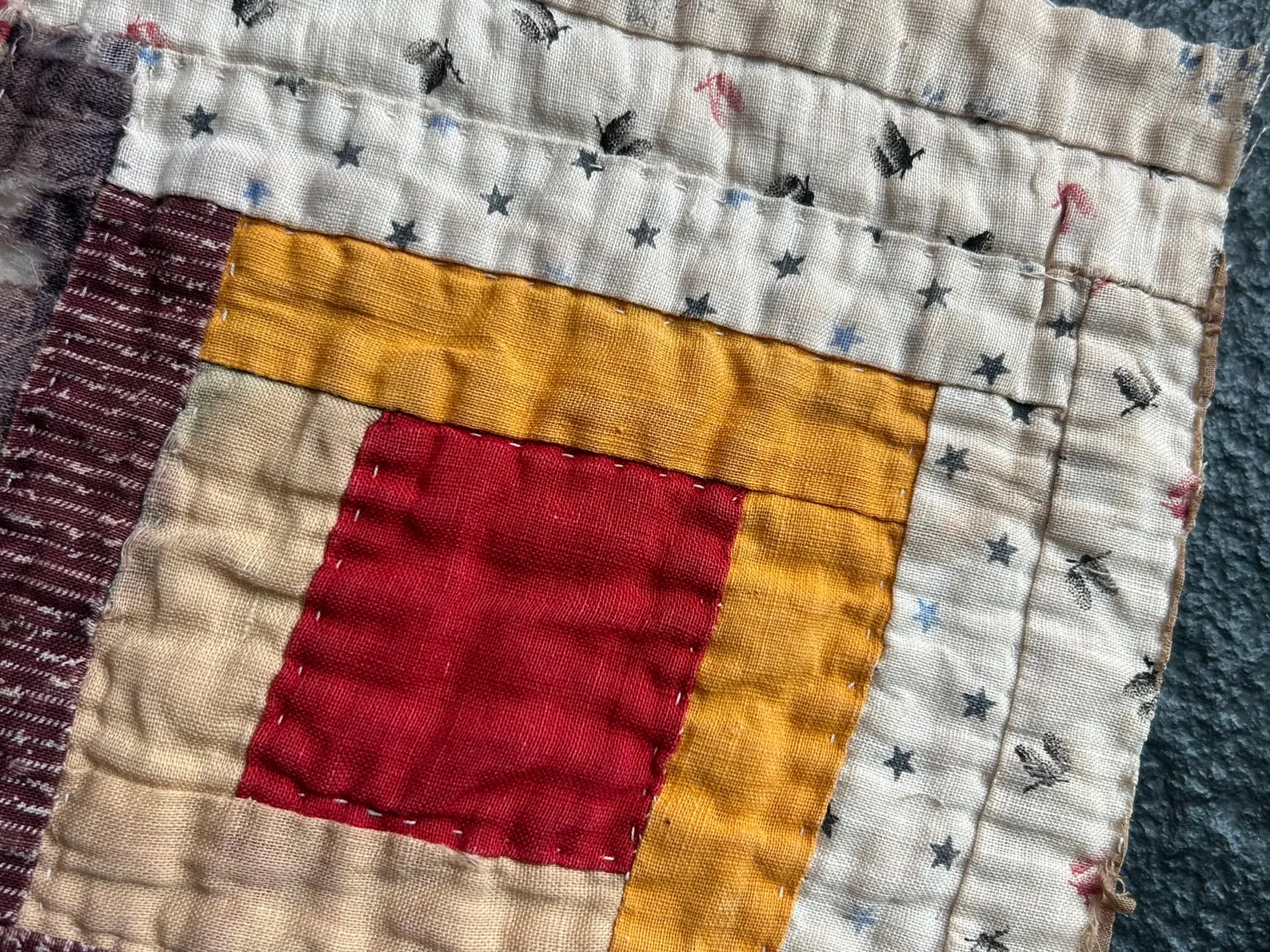
The Victorian versions are where the block gets showy. Wool challenges and silk scraps, sometimes backed on foundation squares of muslin or old shirting, sometimes assembled with no quilting at all in the conventional sense, because the foundation did the structural work. Foundation piecing is central to the block's history. You are not matching seams so much as building outward on a base, which meant a maker could use narrow, unstable, expensive scraps that would be miserable to handle any other way. A block that tolerates silk ribbon remnants is a block that gets made.
The Underground Railroad Claim
Now the part that sent me to the sewing machine in the first place.
The popular version goes like this: a Log Cabin quilt hung on a fence or a clothesline, with a black center square instead of the usual red, signaled a safe house on the Underground Railroad. You have heard it. It gets told at guild meetings, printed in children's books, and repeated in museum gift shops. It is a good story, and I want to be careful here, because I believed it completely and it is the reason I own a sewing machine.
The claim traces to Hidden in Plain View, published in 1999 by Jacqueline Tobin and Raymond Dobard, which presents a quilt code system based on the oral testimony of a single informant, Ozella McDaniel Williams, whom Tobin met in Charleston. That is the evidentiary foundation. One family's oral account, recorded in the 1990s, describing a system said to date to the antebellum period.
What is missing is everything you would want. There are no contemporary 1850s or 1860s documents describing a quilt code. The abolitionist record is not thin, it is substantial, and people who were meticulous about documenting escape networks did not mention it. Neither did the formerly enslaved people interviewed at length in the decades afterward. And the specific problem with the Log Cabin is chronological: the block's documented emergence sits right at the Civil War, not comfortably before it. A signaling system requires a sign both parties already recognize. Historians including Giles Wright and Leigh Fellner have laid out these objections in detail, and the professional consensus has not moved toward the code.
Here is what I have come to think, and it took me a while. The code story is not antebellum history. It is late twentieth century memory culture, and that is a real thing worth studying rather than a consolation prize. It emerged in a period when Black families were reclaiming narratives that institutional history had ignored for a century, when a quilt in a grandmother's closet was one of the only surviving objects from a past that had been systematically undocumented. The story spread because it answered a genuine hunger. Dismissing it as a simple falsehood misses why anyone needed it.
And the documented history is not a downgrade. Enslaved and free Black women made quilts in enormous numbers, under conditions that make the survival of any example remarkable. Harriet Powers's story quilts exist and can be seen. The Gee's Bend quilters in Alabama built an improvisational tradition across generations that scholars now treat as a major body of American art. That record is real, it is attributed, and it does not need a code to be extraordinary.
The Geometry, Which Is the Actual Magic Trick
Strip a Log Cabin down to its logic and it is a spiral with a deliberate asymmetry built in.
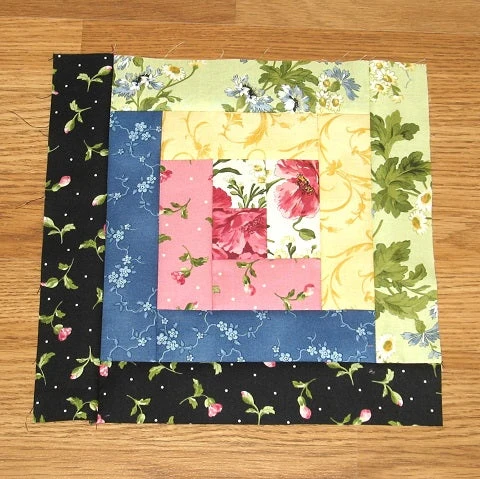
You start with a center square. You add a log to one side, then a log to the adjacent side, then the next, then the next, rotating consistently in one direction. Each log spans the center plus everything added before it on that axis, so logs grow in pairs: two short, two longer, two longer still. That progression is what makes the block square up. If the strips are a consistent finished width and the center is sized to match, the arithmetic closes perfectly every round.
The center square is the variable most people get wrong. If your logs finish at one inch, a center finishing at one inch gives you a tight, even spiral. Make the center larger, say two inches against one inch logs, and the block reads as a framed medallion instead. Neither is incorrect. They are different blocks with the same instructions.
Finished size follows from the round count. Center width plus two times log width times the number of rounds. One inch center, one inch logs, four rounds around: one plus eight, a nine inch finished block. Add the quarter inch seam allowance on every edge when you cut and the math stays honest. This is why Log Cabin scales so well. Want a bigger block, add a round. The proportions hold.
Why the Settings Multiply
The second structural decision is the one that generates everything else. Half the logs are light, half are dark, and the division runs diagonally, so the block has a bright triangle and a shadowed triangle meeting corner to corner.
That gives each block a direction. And a square unit with a direction can be rotated four ways. Every classic Log Cabin setting is just a rule for how you rotate.
Point all the dark corners the same way and the diagonals line up across the whole top into Straight Furrow. Arrange them so the darks group into concentric diamonds radiating from the center and you get Barn Raising, which from across a room stops reading as blocks at all. Cluster lights against lights and darks against darks and you have Sunshine and Shadow. Same block. Same seam. Different arrangement on the design wall.
Change the construction rule instead of the arrangement and you get relatives. Courthouse Steps adds logs to opposite sides in pairs rather than spiraling, which kills the diagonal and produces a symmetrical stepped frame. Pineapple adds logs on the diagonals as well as the sides, trimming corners as it grows, and the spiral turns into a starburst that looks nothing like its parent until you take one apart.
This is the versatility I keep coming back to. A quilter who learns one block and one rule gets a catalog. That is a rare return on investment in this craft, and I think it explains the block's nineteenth century explosion better than any symbolic reading does. It used scraps efficiently, it forgave narrow and awkward fabric, it took foundation piecing beautifully, and it produced radically different quilts from identical labor.
Back to the Crooked One
My first Log Cabin is crooked because I did not understand that the logs have to be cut to a consistent width or the spiral drifts, and a drifting spiral does not square. I know that now. I could fix it. I am not going to.
It was made by someone who had just read a book, believed all of it, and wanted to hold the thing the book was about. The history I have since learned did not take the block away from me. It just replaced one story with a longer one, about Sanitary Commission fairs and silk scraps and a geometry that closes cleanly every single round, and about why a community might need a story badly enough to carry it for fifty years.
The strips still wrap the center the same way they did in 1865. You can feel it happening under your hands.
Bring the Log Cabin to your guild
I walk groups through this block's real history, the code debate, and the geometry that makes every setting work.
More from the Blog

Harriet Powers and the Quilts That Carried History
Born enslaved in Georgia in 1837, Harriet Powers stitched scripture and local history into narrative quilts. What the record actually says about her work.
The Meaning Behind Popular Quilt Blocks
From the Flying Geese to the Log Cabin, every quilt block has a history. These patterns carry stories passed down through generations of American quilters.
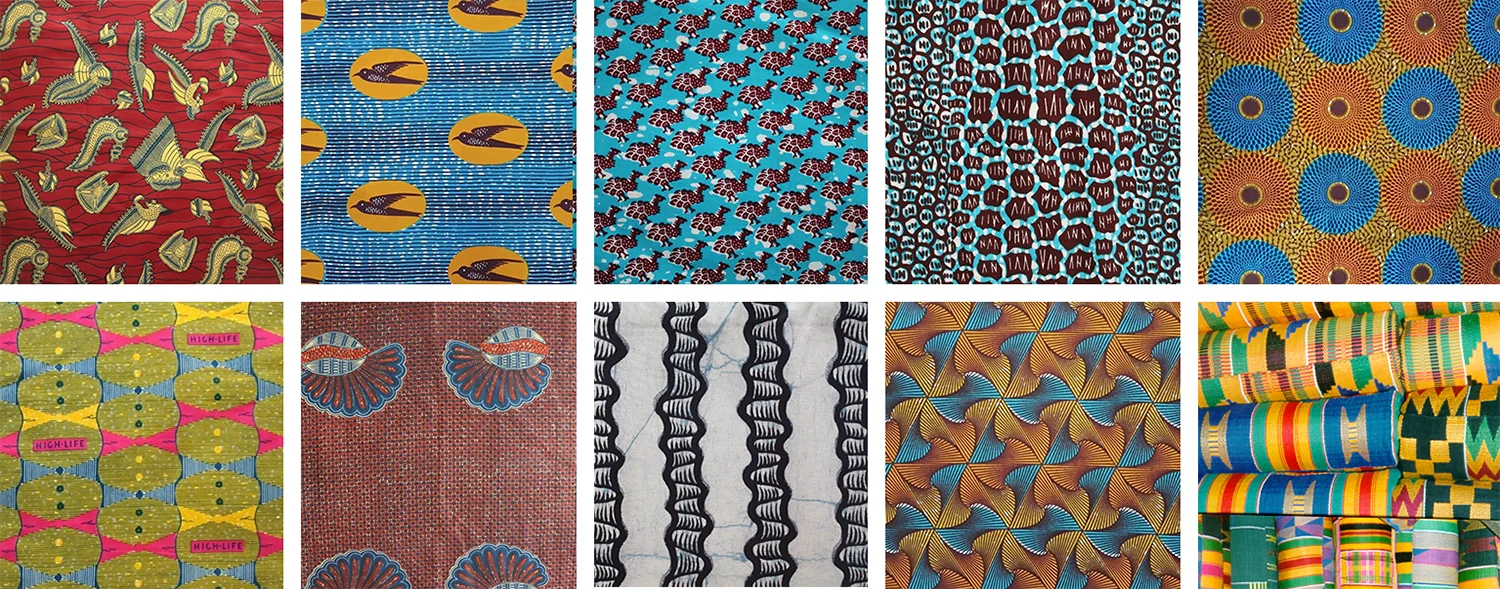
Ten Iconic Symbols in African Print Fabric
African print fabric is one of the most visually rich textile traditions in the world. These ten symbols carry stories of identity, community, and craft.
One Block, A Century of Arguments
The Log Cabin is the block people ask me about most, usually because they have heard the code story and want to know what is behind it. I love that conversation, and I love watching a room work out the geometry in real time. It is one of the talks I give to guilds, universities, and conferences.